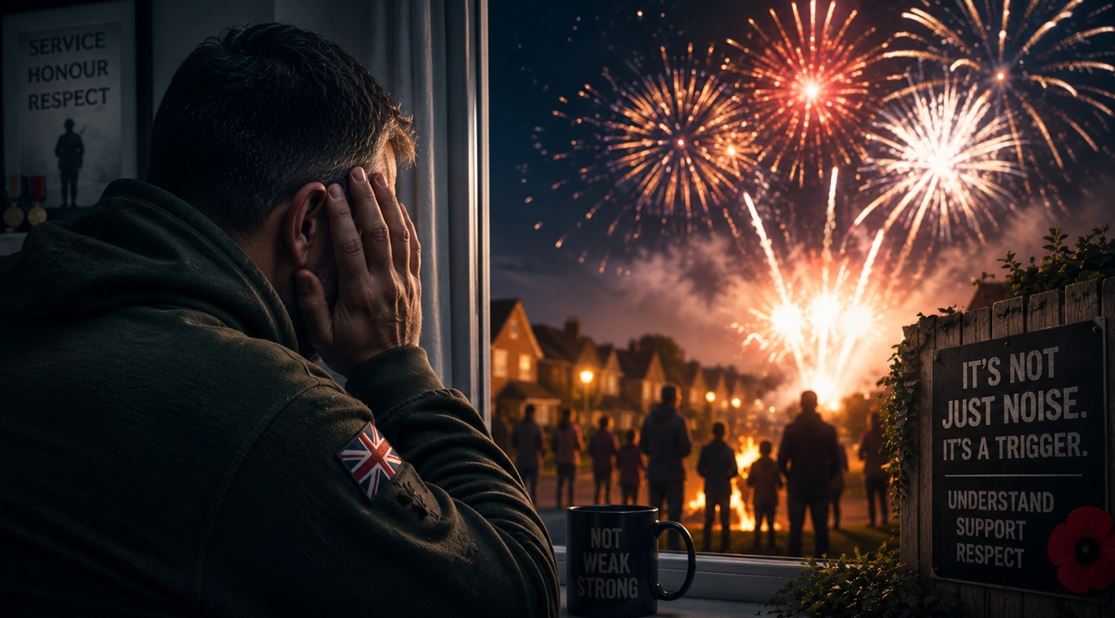
Bonfire Night is a well-established part of the British calendar. Communities gather, fireworks light up the sky, and for the majority of people it is a straightforward occasion of colour and spectacle. For some veterans, the experience is considerably more complicated, and understanding why that is matters for both the veterans themselves and for the communities they live in.
This is not a universal experience and it is important not to overstate it or to create the impression that all veterans find fireworks problematic. Many veterans enjoy Bonfire Night without any difficulty. But for those who do find it challenging, having an honest explanation of what is happening and knowing what can help is genuinely useful.
What the nervous system learned during service
Military service, particularly operational service in environments involving genuine physical threat, recalibrates the nervous system in ways that do not simply reverse when the circumstances change. The biological systems that detect danger and mount a response, accelerated heart rate, heightened alertness, the preparation for rapid action, are trained over years to become more sensitive and more reactive to environmental cues that resemble threat.
This training serves a completely legitimate purpose in operational contexts. The problem is that it persists. The nervous system does not distinguish reliably between a firework and an explosive, between a car backfiring and a weapons discharge. The response to sudden loud noise, particularly high-intensity sharp noise combined with bright flashes of light, can be instantaneous and physiological rather than considered and rational.
For veterans whose service involved sustained exposure to combat, weapons training, blast events or other high-intensity sensory environments, Bonfire Night can trigger exactly those physiological responses even in a context that is objectively safe. The person knows they are in a garden in November, not a combat zone. Their nervous system is less sure, and for a period it responds accordingly.
How veterans describe the experience
Veterans who find Bonfire Night difficult describe a range of experiences. Some describe heightened alertness that begins before the fireworks start, an anticipatory stress that builds through the day as the evening approaches. Some describe specific physical responses to individual explosions: a startle reaction, a surge of adrenaline, a difficulty returning to baseline quickly. Some describe an accumulation of fatigue as the evening goes on, the exhaustion of maintaining composure through a sustained series of unpredictable loud events.
Not all of these experiences indicate PTSD. Some veterans who find Bonfire Night uncomfortable have no PTSD diagnosis and no specific trauma history. The noise sensitivity can be a standalone consequence of sustained exposure to loud environments during service, without the full clinical presentation of post-traumatic stress.
What planning and preparation can do
For veterans who know from experience that Bonfire Night is difficult, planning ahead tends to reduce the impact more reliably than trying to manage it in the moment.
⬤ Knowing the approximate times and locations of local displays in advance reduces the unpredictability that is part of what makes the experience difficult
⬤ Choosing to be indoors during the peak display window, with music or television providing competing sound, gives the nervous system something to attend to
⬤ Noise-cancelling headphones or good ear defenders reduce the intensity of individual bangs significantly
⬤ Spending the evening with one or two people whose company is calming rather than alone or in a large, stimulating group
⬤ Having something specific planned for the following day can help the evening feel like something to get through rather than an open-ended source of anxiety
What communities can do
Awareness is the first practical step. Neighbours who know that someone nearby may find the evening difficult and who give advance notice of when they intend to set off fireworks are doing something small and considerate that can make a real difference to someone’s evening. Organised displays that are registered and advertised allow people to know when and where to expect concentrated noise.