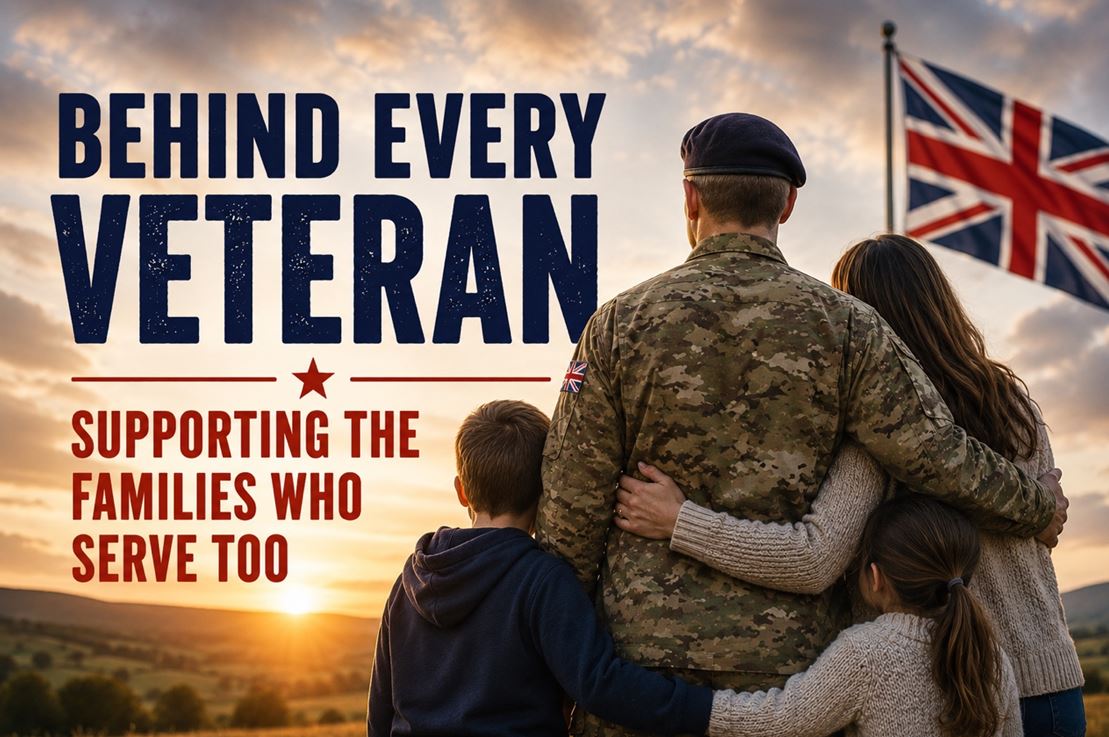
When someone serves in the Armed Forces, their family serves alongside them. Not in uniform and not in the same way, but in the deployments waited out, the phone calls that did not come when expected, the moves between postings that disrupted schools and friendships and careers without adequate acknowledgement, and in the adjustment when service finally ends and the person who returns is not quite the same person who left.
The impact of service on military families does not end with the discharge papers. Partners, children and close family members frequently become the primary support system for a veteran navigating transition, and they do so largely without formal recognition of what that role actually requires or consistent access to support specifically designed for them.
What families are actually managing
The post-service period can create a combination of pressures that civilian families simply do not face in the same way. A veteran managing PTSD, chronic pain, hearing loss, or the anxiety and purposelessness that transition can produce is managing those things within a household. The people in that household experience the effects continuously.
Partners of veterans with PTSD can develop mental health difficulties themselves as a result of sustained secondary exposure to trauma responses. Research from Combat Stress has documented this pattern consistently. The hypervigilance that causes a veteran to be alert and reactive in the night affects the sleep of everyone in the house. The social withdrawal that limits the veteran’s engagement with the world limits the social life of the family. The communication difficulties that arise from trauma, from hearing loss, or from the simply different communication norms that military culture instils, shape every conversation in the household.
Financial pressure compounds everything else. The shift from military to civilian income is often significant. Where a veteran is struggling to maintain employment due to health conditions, the family absorbs the financial impact as well as the emotional one. Many partners carry both a disproportionate share of household management and a disproportionate share of financial provision through the transition period, without either being formally acknowledged.
Children in military families
Children notice considerably more than adults tend to assume. A parent who is withdrawn, who reacts unpredictably to noise, who is emotionally distant, who is visibly struggling: all of these are experienced by children, even when adults believe they are successfully shielding them from what is happening.
Children in this situation sometimes take on inappropriate caring roles, positioning themselves as responsible for managing the parent’s emotional state in ways that are developmentally unsuitable. Others develop anxiety, sleep difficulties or behavioural changes that reflect the emotional atmosphere of the household rather than any specific identifiable cause. Still others simply carry a quiet uncertainty about what is happening at home that goes unaddressed because the adults are managing it silently.
The Lighthouse Programme provides free therapeutic support for children and young people from military families, including those whose parents have left service. It is available through Veterans’ Gateway (0808 802 1212) and through SSAFA. Place2Be provides school-based counselling across the UK and has specific experience of military family contexts.
Support specifically for families and partners
The Ripple Pond exists specifically for adult family members of veterans with physical, psychological or moral injury. Membership is free, no proof of injury is required, and it is open to partners, parents, siblings, adult children and chosen family. It provides peer support, one-to-one support and an online community specifically designed for people in the family supporter role. Website: theripplepond.org | Telephone: 0333 900 1028.
Combat Stress provides support for families as well as veterans, including a Together Programme for partners and a 24-hour helpline (0800 138 1619) that is available to family members as well as veterans. SSAFA offers family welfare support including counselling, housing advice and financial help. The three Families Federations, for Army, Royal Navy and RAF families, provide practical advice and advocacy tailored to each community.
The thing families most need to hear
Your wellbeing matters and is not secondary to the veteran’s needs. The tendency to place it entirely second, to run on empty as a consequence of sustained care for someone else, is understandable but not sustainable and does not ultimately serve the veteran either. Families who access support for themselves, as well as for the veteran they are supporting, navigate the transition period more successfully and build more durable post-service lives.
Looking after yourself is not a distraction from the task of supporting a veteran. It is the foundation that makes sustained support possible. The organisations listed above are there for you as well as for the veteran, and none of them will judge you for reaching out.
📚 Free guides: heroeshub.uk.com
📞 Hearing loss claims – Justice4Heroes: 0800 776 5622
🌐 heroeshub.uk.com